PRICING CARBON, REGULATING INDUSTRY: WHAT DOES INDIA’s CCTS ROLLOUT ENTAIL?
At the inaugural session of International Conference on Carbon Markets- Prakriti 2026, the Union Power Minister, Manohar Lal Khattar announced the launch of the Indian Carbon Market Portal. The portal is a centralized digital platform designed to administer and implement the carbon market, streamlining processes of registration, monitoring, verification and trading of carbon credit certificates. The launch of the Portal is a significant step in operationalising India’s Carbon Credit Trading Scheme (“CCTS”).
Climate Commitments Behind the CCTS
Carbon pricing mechanisms are key instruments in the global effort to address climate change. Article 6 of the Paris Agreement establishes a global carbon market as part of its commitment to limit the rise in global average temperature to below 2 degrees Celsius by the end of this century. India ratified this agreement in 2016 and as part of its Nationally Determined Contributions (NDCs), pledged to reduce emissions intensity by 45% by 2030 (from 2005 levels), and pledged to achieve net-zero emissions by 2070.
From Command-and-Control to Market-Based Regulation
Meeting these international and domestic commitments requires a domestic policy instrument that can translate pledges into enforceable, on-the-ground action. Traditionally reliant on command-and-control regulation (CAC), a system in which the government fixes uniform standards and directly orders compliance, rather than relying on price signals, India is now transitioning more towards market-based instruments to incentivise emissions reduction. In order to meet these NDC commitments and honour its Paris Agreement obligations, the CCTS thus represents the country’s first comprehensive attempt to establish a robust domestic carbon market. This blog maps out the design, functioning and likely trajectory of India’s Carbon Trading Scheme.
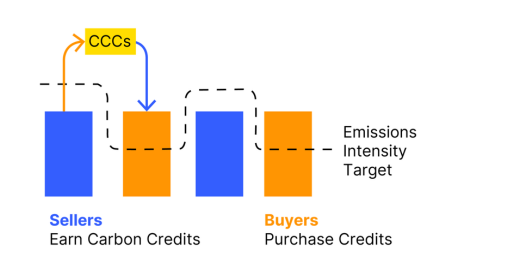
The CCTS was first notified in June 2023, and pursuant to amendments made in 2022 to the Energy Conservation Act, 2001, Section 14(w) empowers the central government to specify the carbon credit trading scheme. India has adopted a baseline-and-credit model using FY 2024 as the baseline year. Under this scheme, A Carbon Credit Certificate or CCC, represents one (1) tonne of CO2 that is reduced or removed via processes like sequestration, and this certificate is awarded to entities that fulfil prescribed emission targets. Those who fail to reduce their emissions to prescribed targets would have to purchase credits in order to comply. Entities that beat their targets can sell their surplus certificates, while entities that fall short must buy certificates to cover the gap. This creates a market of buyers and sellers that puts a price on emissions. It encourages emission reduction though economic incentives rather than the earlier direct mandates under the previous CAC model.
Institutional Architecture of the Indian Carbon Market
The institutional framework of the carbon market in India comprises of 4 bodies. At the apex is the National Steering Committee for the Indian Carbon Market (NSC-ICM), which provides policy oversight and governance. The Bureau of Energy Efficiency (BEE), which functions under the Ministry of Power, acts as the central administrator responsible for identifying sectors, recommending targets and overseeing compliance mechanisms. The financial support for implementation of the CCTS is to be met by the BEE from fees collected through other entities and itself. The Central Electricity Regulatory Commission (CERC) is the market regulator whose task is to supervise trading and to issue regulations pertaining to the purchase and sale of CCCs. The Grid Controller of India is tasked with registry functions. It maintains electronic records of issuance, ownership and transfer of CCCs.
How the CCTS Works: Compliance and Offset Markets
The Carbon Trading Scheme began its shift from the Perform, Achieve, and Trade (“PAT”) Scheme in 2025 with its first compliance years as FY2026 and FY 2027. The scheme functions through a dual-market structure comprising of compliance and offset mechanisms. Compliance with the scheme and its benchmark notified by the government is mandatory for energy intensive industries like cement, aluminium, textiles, chlor-alkali, iron and steel, paper and pulp, petroleum refining, petrochemicals, etc. The BEE recommends these targets based on sectoral potential and technological feasibility. Thus, the CCTS operates through sector-specific targets rather than imposing an absolute cap on total emissions.
On the other hand, the offset market is voluntary and allows non-obligated entities such as NGOs to generate credits through emission reduction projects. While the compliance market creates demand for credits, the offset market generates the supply. This dual system lets market forces of demand and supply drive price discovery and liquidity. To keep prices from swinging too far in either direction, it also builds in price floors and price ceilings.

Verification and Enforcement
Since verification and enforcement are integral to compliance and credibility of the system, emission reductions and performance is validated by Accredited Carbon Verification Agencies (ACVAs), to ensure that reported reductions are accurate and compliant with prescribed methods of calculation. The issuance of CCCs is contingent upon this Monitoring, Reporting and Verification (“MRV”) process. Although the statutory framework provides for compliance obligations, the details of penalties and enforcement mechanisms are still in the process of evolving through subordinate regulations and other guidelines. Thus, the functioning of the CCTS represents a hybrid model combining regulatory mandates with market flexibility, to reduce emissions while accounting for India’s developmental goals.
Concerns and Critiques
The CCTS is an ambitious but necessary step in fulfilling India’s climate commitments. However, climate finance and policy experts have raised several concerns that are worth examining, as flagged by organisations such as the Institute for Energy Economics and Financial Analysis (IEEFA) and the Centre for Science and Environment (CSE). The rest of this section examines each of these in turn: the choice of intensity-based targets over an absolute cap, incomplete sectoral coverage and delays in the rollout, and open questions around enforcement. The most fundamental critique is on India’s choice to set targets based on intensity of emissions (emissions per unit of output) rather than an absolute cap on total emissions. Unlike established cap-and-trade systems like the EU ETS or California’s cap-and-trade, India’s CCTS lacks such a hard cap in absolute terms. Therefore, even if a cement or steel plant meets its intensity target, the total emissions can continue to rise as production increases and still continue to generate credits. Surplus credit accumulation in such a manner could supress prices below levels that are needed to drive meaningful change. The Institute for Energy Economics and Financial Analysis has already flagged how markets without early price stability mechanisms have faced prolonged periods of ineffective price discovery.
Another critique is that of incomplete sectoral coverage and delays in the rollout. CCTS currently envisages nine sectors and India has notified targets only for four sectors after a significant delay. Thermal power has also not been identified as a sector despite its role in contributing to nearly 40% of total GHG emissions.
The Centre for Science and Environment also notes that the staggered and delayed rollout risks an oversupply of credits that could weaken its credibility. The report notes that CCTS was largely built upon the previous system of the Perform, Achieve and Trade (PAT) scheme. These PAT’s targets were modest, like the intensity targets, which allowed many industries to over-achieve with respect to certificates, leading to a price collapse.
Enforcement also remains an open question at this stage. As mentioned, the robustness of the scheme depends on compliance verification as well as penalties for non-compliance. Poor compliance with PAT and with CCTS being based on it, raises concerns regarding the roles of institutions within the framework. The effectiveness of the framework will depend on detailed procedures that are yet to be sent out by the BEE.
Conclusion: A Foundation, Not a Finished Market
To conclude, India’s CCTS is best understood as a foundation. It marks a shift in how we are approaching reduction in emissions by moving from CAC to more market-based mechanisms and from PAT to CCTS. While this is a significant step in realising India’s climate goals, a market that sets soft targets, risks oversupply of credits and has insufficient sectoral coverage is not one that will be efficient. It must not leave out major emitters like thermal power, as discussed above, and delay notifying targets. With formal trading of compliance-based carbon credits expected to be launched by mid-2026, the coming years would be a true test of the scheme. If the concerns are addressed in a timely manner, India’s CCTS could grow into what could be one of the world’s largest and most significant carbon markets. India could build a transparent and credible carbon market that will serve as a long-term national asset. It’s likely trajectory, then depends upon whether the government tightens targets, expands sectoral coverage and builds credible enforcement over the coming compliance cycles.
[This post has been authored by Dhriti Atreya, a third-year law student at JGLS]


Comments